Athletics · Careers
How to build an athletics career in Nigeria
From school sports to Team Nigeria: talent hunts, scholarships, prize money, anti-doping rules and advice from Nigeria's track and field greats.
Advertisement
Careers in athletics
Your road to Team Nigeria
Athletics is Nigeria's most successful Olympic sport, and it is one of the most open: you need running shoes, a coach and the will to train. Chioma Ajunwa won Olympic gold in 1996, Tobi Amusan became world champion and world record holder in 2022, and Ese Brume broke the African long jump record while studying at a Nigerian university.
This page is for young athletes, parents, PE teachers and coaches. It explains how talent is found in Nigeria, how to reach the national team, how US university scholarships work, what athletes really earn, the anti-doping rules every Nigerian athlete must know, and the coaching and officiating careers in the sport. Everything was checked on 1 October 2026.
The honest truth: very few athletes earn a full living from competing. The ones who last combine talent with education, a good coach and clean, patient training.
Career facts · Checked 1 October 2026
Nigerian athletics careers in numbers
-
$70k
World Championships gold
Plus a $100,000 bonus for a world record.
-
16
NCAA core courses
Needed for a US university scholarship.
-
3
Out-of-competition tests
Minimum for Category A athletes before a major event.
-
7.17m
Brume's African record
Set in 2021 by a Delta State University product.
The pathway at a glance
Six stages from school sports to the world stage
Ages are a guide. Many athletes find their best event late, so keep trying.
Age 8 to 14
School sports and inter-house
Most Nigerian athletes are discovered by a PE teacher at school sports. Try sprints, jumps and throws.
Age 12 to 18
Talent hunts
MTN Champs (Making of Champions) runs zonal rounds and a grand finale, with scholarships for selected athletes.
Age 12 to 18
National Youth Games
Run by the National Sports Commission for all 36 states and the FCT. Favour Ofili won the girls' 400m in 2017.
Age 15 to 19
African and world junior events
African youth and junior championships and the World Athletics U20 Championships, held every two years.
Age 17 to 23
University: at home or abroad
Ese Brume stayed at Delta State University; Amusan (UTEP) and Ofili (LSU) took US scholarships.
Age 18 and up
AFN trials and Team Nigeria
National championships and trials. Major teams need the entry standard or a world ranking quota place.
Step by step
Eight steps to an athletics career
Follow these in order. Clean, patient training wins in the end.
Try every event, then find your best
Young athletes should sample sprints, hurdles, jumps and throws before specialising. Brume, Amusan and Ofili all came through school sport. The Nigeria School Sports Federation has been training PE teachers in talent identification so that more children are spotted early.
Find a qualified coach
Favour Ofili started as a secondary school student in Delta State, guided by her coach Anne Otutu. A good coach plans your training, protects you from overtraining and helps you avoid injuries. Ask whether a coach holds a World Athletics coaching certificate (Level I is for under-16 athletes, Level II for under-20).
Compete in talent hunts and youth games
Results are your CV. Enter school championships, MTN Champs zonal rounds, state trials for the National Youth Games and later the National Sports Festival. Making of Champions says many athletes it discovered are now competing in US university athletics.
Keep your grades as high as your performances
Mary Onyali, a five-time Olympian, says sport and education must go hand in hand. Scholarships abroad need academic results too, and education protects you after your running days end.
Earn international experience as a junior
The World Athletics U20 Championships are open to athletes aged 19 or younger on 31 December of the competition year. Nigeria won shot put gold at the 2026 edition in Eugene through Jessica Oji. Tobi Amusan won African junior and African Games gold at 18 in 2015.
Choose your university route
There are two proven routes. Stay home: Ese Brume studied at Delta State University and went on to Commonwealth gold, world medals and an Olympic bronze. Go abroad: Amusan won an NCAA title at UTEP in 2017, and Ofili became the first collegiate woman under 22 seconds in the 200m at LSU. See the scholarship rules below.
Make Team Nigeria through the AFN trials
The Athletics Federation of Nigeria (AFN) selects teams from national trials and rankings. For the 2025 World Championships it picked only athletes who had the entry standard or a top place in the world ranking quota. Plan your season so you peak for trials and chase qualifying marks at permitted meetings.
Train clean, and learn the anti-doping rules early
Nigeria is in the highest anti-doping risk category, so national team athletes face extra testing. One positive test or three missed tests can end a career. Read the anti-doping section below before your first international call-up.
Advertisement
Abroad
University scholarships: the rules
A US university scholarship gives an athlete coaching, competition, facilities and a degree. Nigerians have used it brilliantly, but the rules are strict.
NCAA academic rules for international students
- Complete 16 NCAA-approved core courses before secondary school graduation.
- Reach a minimum core GPA of 2.3 for Division I or 2.2 for Division II.
- Submit official transcripts from year nine onward, with a certified English translation where needed, and proof of graduation.
- Register with the NCAA Eligibility Center, which certifies your academics and amateur status.
More places on teams
Since 1 July 2025, schools that opt in to the new NCAA system use roster limits (45 athletes per men's or women's track team) instead of the old scholarship caps, and may award scholarships to any or all rostered athletes.
Junior colleges
Junior colleges (NJCAA) are a stepping stone. Division I junior colleges can give full scholarships, Division II partial ones, and Division III no athletic aid. Athletes who move on to a university must then meet its academic standards.
Do you have to leave Nigeria?
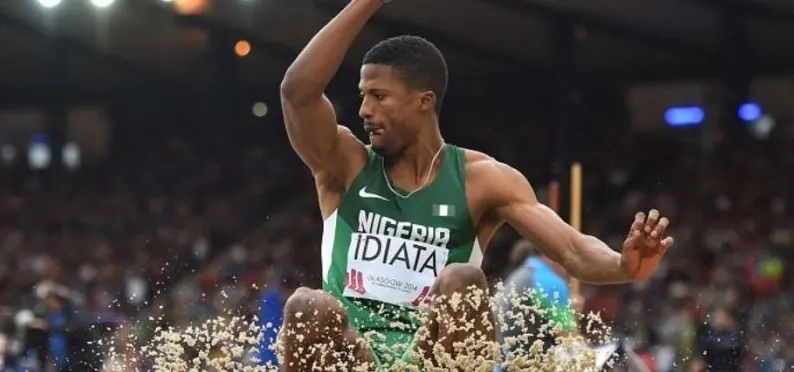
No. Ese Brume came through the Nigerian championships and Delta State University, and her 7.17m in 2021 broke Chioma Ajunwa's African long jump record.
Pay
Making a living from athletics
Athletics pays well at the very top and modestly below it. These are the verified figures.
| Source of income | Amount | Notes |
|---|---|---|
| World Championships | $70,000 gold, $35,000 silver, $22,000 bronze | Plus a $100,000 world record bonus |
| Diamond League meeting win | $10,000 ($20,000 in Diamond+ events) | Places 2 to 8 also paid |
| Diamond League Final win | $30,000 ($50,000 in Diamond+ events) | Equal for men and women |
| NSC training grants | $20,000 per athlete (April 2025) | Amusan, Ofili and Onwuzurike among recipients |
| NSC grants, 2026 | Over ₦200 million shared by 26 athletes | Ahead of the 2026 Commonwealth Games |
| Kit sponsor bonus | $20,000 to Amusan for 2025 world silver | Paid by HiRacer, the AFN's kit supplier |
Below the elite level, money is hard. A 2020 Sportico report found that around half of US track athletes ranked in the world top 10 earned less than $15,000 a year from the sport (as of 2014). Shoe contracts often include race quotas and pay cuts if targets are missed. Read every contract with a lawyer, and keep studying.
Stay clean
Anti-doping: what every Nigerian athlete must know
This section can save your career.
- The Athletics Integrity Unit (AIU) puts national federations in categories A, B and C. Nigeria is Category A, the highest risk group (confirmed again in April 2026).
- A Category A athlete must have at least three no-notice out-of-competition tests, at least three weeks apart, in the ten months before a major championship. No tests, no championship.
- Athletes in the testing pool must file their whereabouts and be available for a 60-minute slot every day. Three filing failures or missed tests in 12 months is a violation, usually a two-year ban.
- Tobi Amusan was charged with three whereabouts failures in 2023. A tribunal cleared her, and the Court of Arbitration for Sport confirmed it on 28 June 2024. Even a world champion has to take the paperwork seriously.
- Nigeria's National Anti-Doping Act created the Nigeria Anti-Doping Centre, and its Technical Board was inaugurated on 3 July 2026.
Clean sport rules to live by
- Check every medicine and supplement before you take it, and keep the receipt.
- Tell every doctor that you are a tested athlete.
- Update your whereabouts the moment your plans change.
- Never accept a “magic” drink, injection or pill from anyone.
Beyond competing
Careers around the track
Athletics needs coaches, officials and administrators at every meeting in Nigeria.
| Career | How to start | Next level |
|---|---|---|
| Coach | Apply through the Athletics Federation of Nigeria for a World Athletics Level I course (coaching under-16 athletes). | Level II (under-20) through the AFN, then Level III for senior athletes. |
| Technical official | World Athletics Level I courses, run by member federations such as the AFN, make you a National Technical Official. | Level II: Area International Technical Official. Level III: the World Athletics international panel. |
| Talent spotter | PE teachers can join Nigeria School Sports Federation talent identification training. | School, state and national development programmes. |
Advice from the stars
What Nigeria's track and field greats want you to know
Every quote below was checked word for word against the outlet named under it. We add one practical lesson to each.
Sports and education must go hand-in-hand. Both are important and must be balanced.
Mary OnyaliFive-time Olympian and Olympic medallist
The Guardian (Nigeria), 20 April 2026The lesson: Your books and your spikes are equally important.
The Rio Olympics taught me that you should never look down on yourself, and you should stick to what you believe in.
Ese BrumeAfrican long jump record holder
World Athletics feature, 7 December 2019The lesson: Belief carries you through the bad competitions.
If you are healthy, you can really do anything.
Favour OfiliFormer LSU sprint star
World Athletics feature, 4 May 2022The lesson: Protect your body: rest, eat well and treat injuries early.
I am proof anyone can rise to the top, irrespective of background.
Chioma AjunwaNigeria's first Olympic gold medallist (1996)
BellaNaija, 9 August 2021The lesson: Where you start does not decide where you finish.
Never let doubt stop you.
Tobi Amusan2022 world champion and former world record holder
Sports247, 16 May 2026The lesson: Doubt is normal. Train anyway.
Your first move
Where to start this week
Start your athletics journey this week:
- Tell your PE teacher you want to try out for school sports.
- Find a coach or club near you and ask about training times.
- Try at least one sprint, one jump and one throw.
- Keep a training diary: what you did, how you felt, your times and distances.
- Keep your school grades strong: they open scholarship doors.
- Learn the basics of clean sport before your first big competition.
- Parents and coaches: contact the Athletics Federation of Nigeria for official programmes.
The AFN's details are on our Contact Nigerian athletics page, and Nigerians competing abroad are tracked weekly on Nigerian athletes abroad.
Keep exploring
Explore Nigerian athletics
Quick answers
Athletics careers in Nigeria: your questions
Do I need to go to the US to succeed in athletics?
No. Ese Brume came through the Nigerian championships and Delta State University and won world and Olympic medals. Tobi Amusan (UTEP) and Favour Ofili (LSU) used US scholarships to develop. Both routes work.
How do I get a US track and field scholarship?
Complete 16 NCAA core courses with a core GPA of at least 2.3 for Division I or 2.2 for Division II, send translated transcripts and proof of graduation to the NCAA Eligibility Center, and build results at events such as MTN Champs, the National Youth Games and AFN championships.
How much can a top athlete earn?
World Championships gold is worth $70,000, silver $35,000 and bronze $22,000. A Diamond League meeting win pays $10,000, or $20,000 in Diamond+ events. Most income comes from sponsors, and many athletes earn modestly.
What are whereabouts rules?
Elite athletes must report where they will be and be available for a 60-minute testing slot every day. Three filing failures or missed tests in 12 months can bring a two-year ban.
Why do Nigerian athletes need extra drug tests?
Nigeria is in the Athletics Integrity Unit's Category A, so national team athletes need at least three no-notice out-of-competition tests in the ten months before a major championship.
How do I qualify for Team Nigeria?
Compete at the AFN national championships and trials. For major championships the AFN selects athletes who have the entry standard or a qualifying place in the World Athletics ranking quota.
How do I become an athletics coach or official in Nigeria?
Apply through the Athletics Federation of Nigeria for World Athletics Level I coaching or technical official courses, then progress to Levels II and III.