Football · History
History of Football in Nigeria
From the barefoot 1949 tour to Olympic gold and African titles.
Advertisement
Our history
History of the Super Eagles
The Nigeria national football team, popularly known as the Super Eagles of Nigeria represents the country at the international association soccer competition. They are known as the champion team in Nigeria that have a widespread reputation with a number of awards won at the local and international championships.
After its foundation, the team played its very first recorded games abroad in England in 1949, arriving in Liverpool on 29 August 1949 and playing nine matches, many of them barefoot, against English amateur football teams which included South Liverpool, Dulwich Hamlet and Bishop Auckland. The first official international match followed on 8 October 1949, a 2 - 0 win over Sierra Leone in Freetown.
Their famous achievements commenced years after, when they won the gold medal in 1973 at the 2nd edition of All-Africa Games hosted in Lagos Nigeria. In the subsequent years 1976 and 1978 the Super Eagles finished 3rd in African Nation’s Cup.
The team captained by Chukwu Christian won the 1980 African Cup of Nation as the First championship, beating Algeria 3 - 0 in the final. That was during the 12th edition of the Cup hosted by Nigeria in Lagos.
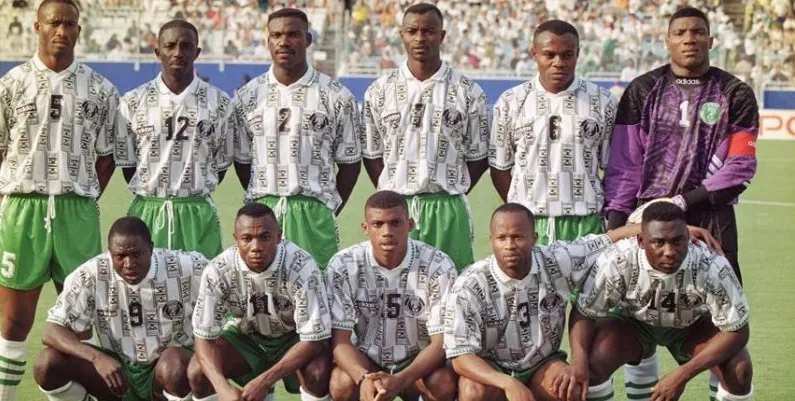
In 1994, the Super Eagles of Nigeria reached the FIFA World Cup for the very first time. During the competition, the team defeated Bulgaria with a 3 - 0 score, lost to Argentina 1 - 2 and then beat Greece 2 - 0 to top their group and reach the second round.
However, in the second round of the competition, Emmanuel Amunike scored a goal 25 minutes after kick-off to give the Super Eagles the lead against Italy, but the game was finally lost 2 - 1 after extra time.
Again, in 1998 the team competed in the FIFA World Cup, playing Spain, Bulgaria and Paraguay in group D. They qualified from the first round by defeating Spain 3 - 2 and Bulgaria 1 - 0, though they lost to Paraguay. In the round of 16 the game ended in favour of Denmark with a 4 - 1 score.
The Nigerian team won the men’s football event at the 1996 Summer Olympics in Atlanta, knocking off Mexico, Brazil and Argentina to win the gold medal in football. They also reached the final of the 2008 Summer Olympics in Beijing but lost the match 1 - 0 to Argentina, taking the silver medal.
Super Eagles were drawn in group F at the 2002 FIFA World Cup to play Sweden, Argentina and England. They lost 1 - 0 to Argentina and 2 - 1 to Sweden and completed the group with a 0 - 0 draw against England. Similarly, during the 2010 FIFA World Cup they played Argentina, Greece and South Korea; they lost against Argentina and Greece but drew the last game with South Korea 2 - 2.
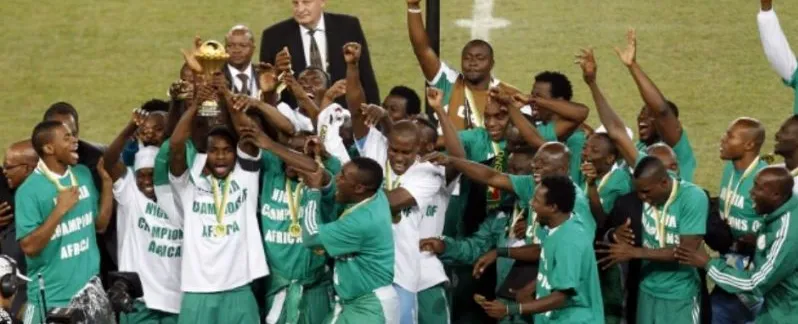
The team won the 2013 African Cup of Nations final on the 10th of February 2013 at the FNB Stadium in Johannesburg, South Africa. A goal scored by Sunday Mba gave them a 1 - 0 win over Burkina Faso and qualified Nigeria to represent the Confederation of African Football at the 2013 FIFA Confederations Cup.
Super Eagles have participated in several matches with different countries who have been occasional rivals. In 2013 FIFA Confederation Cup, the Super Eagles team were grouped with Spain, Uruguay and Tahiti.
They beat Tahiti 6 - 1 in their opening game but lost 1 - 2 to Uruguay and 0 - 3 to Spain. They also played at the 2014 FIFA World Cup, where they reached the round of 16 before losing 2 - 0 to France.
Another challenge came to the team during qualifying for the 2015 African Cup of Nations. At the Godswill Akpabio International Stadium, Uyo, Akwa Ibom State, Nigeria, the Super Eagles drew 2 - 2 with South Africa in their last group game. They finished with a total of 8 points, third in the group, and failed to qualify, so they were unable to defend their title.
In 2016, the Nigeria Super Eagles were grouped with Zambia, Algeria, and Cameroon in a group known as "group of death" according to the draw for the 3rd round of the World Cup qualifiers released by The Confederation of African Football on the 24th of June 2016.
In the first match, Nigeria defeated Zambia 2 - 1 in Ndola and beat Algeria 3 - 1 in Uyo, Akwa Ibom, in the second match. The team then beat Cameroon 4 - 0 in Uyo and drew 1 - 1 in Yaoundé in a back to back contest. They became the first African team to qualify for the 2018 World Cup in Russia, held from 14 June to 15 July 2018, after beating Zambia 1 - 0 in Uyo on 7 October 2017.
In 2018, a renowned Nigeria football player captain Mikel Obi joined the Nigeria Super Eagles team during their preparation camping at the Eagles’ Ibom Hotels and Golf Resort in Uyo for 2018 FIFA World Cup in Russia, making the team 29 in number.
Verified timeline · checked 30 September 2026
Nigerian football: a timeline
- 1945The Nigeria Football Association is founded (renamed the Nigeria Football Federation in 2008).
- 1949First tour abroad: the team arrives in Liverpool on 29 August and plays 9 matches in England, many barefoot. First official international: Sierra Leone 0-2 Nigeria, 8 October.
- 1959-60Nigeria joins CAF (1959) and FIFA (1960). After independence the Red Devils become the Green Eagles.
- 1973Gold at the 2nd All-Africa Games in Lagos.
- 1980First AFCON title: 3-0 against Algeria in Lagos, with Segun Odegbami scoring twice.
- 1985The Golden Eaglets win the first FIFA U-16 World Championship in China.
- 1988AFCON runners-up; the Green Eagles are renamed the Super Eagles.
- 1989The Flying Eagles’ Miracle of Dammam: from 4-0 down to beat the USSR on penalties, then World Youth Championship runners-up.
- 1991The Super Falcons win the first African Women’s Championship and play at the first Women’s World Cup.
- 1994Second AFCON title in Tunis, and a first World Cup in the USA, topping the group.
- 1996Olympic gold in Atlanta: 4-3 against Brazil (Kanu’s golden goal) and 3-2 against Argentina in the final.
- 1999The Super Falcons reach the Women’s World Cup quarter-finals.
- 2008Olympic silver in Beijing.
- 2013Third AFCON title under Stephen Keshi; a fourth U-17 world title in the UAE.
- 2015Victor Osimhen scores 10 goals as the Golden Eaglets win a fifth U-17 world title.
- 2016Olympic bronze in Rio.
- 2017Nigeria are the first African team to qualify for Russia 2018.
- 2024AFCON runners-up in Côte d’Ivoire; Ademola Lookman is named African Footballer of the Year.
- 2025The Super Falcons win a 10th African title; the Super Eagles finish third at AFCON but miss the 2026 World Cup on penalties.
Keep reading
Football in Nigeria
Nigeria’s favourite sport and its national teams.Read more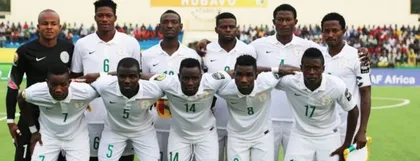
Super Eagles
Nigeria’s men’s team: 3 AFCON titles, 6 World Cups.Read more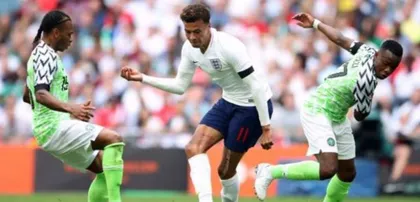
Super Eagles at the World Cup
Every World Cup from USA 1994 to Russia 2018.Read more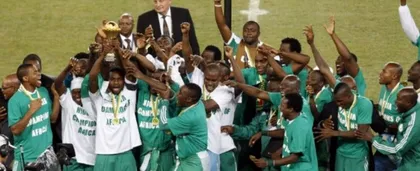
AFCON and Olympic football
Three African titles and the 1996 Olympic gold.Read more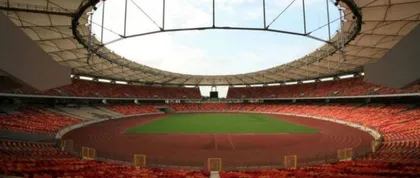
Super Eagles stadiums
The MKO Abiola Stadium in Abuja and other home grounds.Read more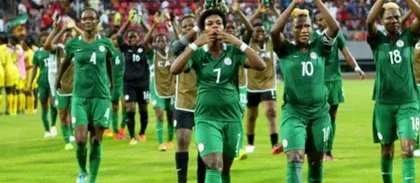
Super Falcons
Africa’s queens: 10 continental titles.Read more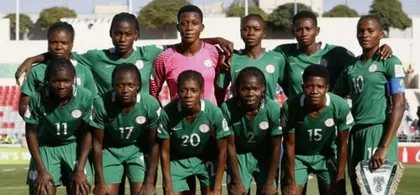
Nigeria’s youth teams
Golden Eaglets, Flying Eagles, Flamingos and Falconets.Read more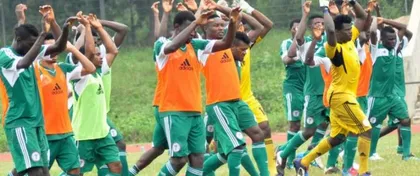
Golden Eaglets (U-17)
Five-time FIFA U-17 world champions.Read more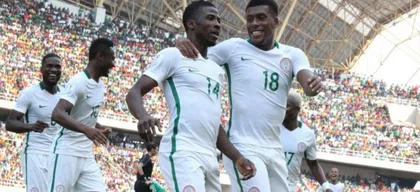
Flying Eagles (U-20)
Two World Cup finals and the Miracle of Dammam.Read more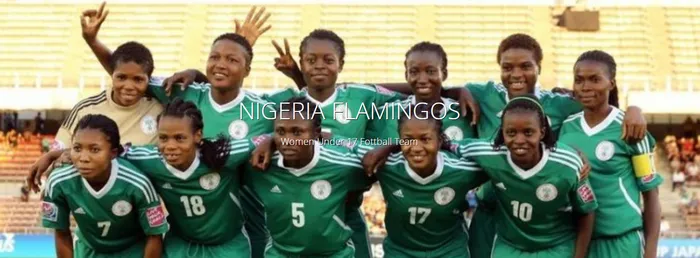
Flamingos (women’s U-17)
World Cup bronze in 2022.Read more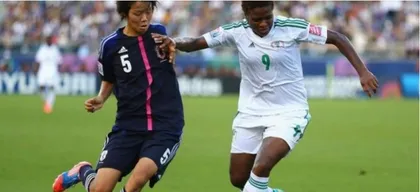
Falconets (women’s U-20)
Two World Cup finals, 2010 and 2014.Read more
Nigerian footballers
Kanu, Okocha, Yekini, Osimhen, Oshoala and more.Read more
Nigerians in the Premier League
Weekly tracker: Iwobi, Bassey, Saka, Eze and every Nigerian in the EPL.Read more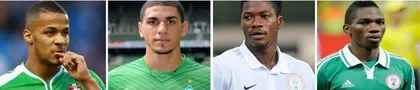
Nigerians in Europe
Weekly tracker: Osimhen, Lookman, Ndidi, Ajibade and more.Read more
Rising Stars
The next generation of Nigerian football, updated weekly.Read more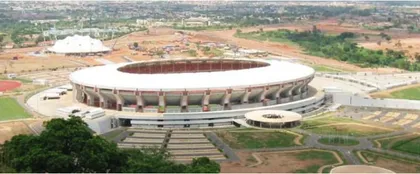
Contact the NFF
Nigeria Football Federation, Abuja.Read more
Quick answers
Football history: quick answers
When did Nigeria play its first international football match?
On 8 October 1949, beating Sierra Leone 2-0 in Freetown, after a tour of England in which the team played 9 matches, many of them barefoot.
Why are Nigeria called the Super Eagles?
The team was the Red Devils before independence and the Green Eagles after 1960. After the 1988 Africa Cup of Nations it was renamed the Super Eagles.
When was the Nigeria Football Federation founded?
In 1945, as the Nigeria Football Association. It joined CAF in 1959 and FIFA in 1960, and was renamed the Nigeria Football Federation in 2008.